A while back, I wrote an essay for a Gothic Literature class on Dracula and sexuality. References to Freud were a requirement for the assignment… but it still turned out good! I hope you enjoy this academic delve into the world’s most classic vampire.
(For anyone who’s curious, yes I got an A on this assignment!)
If you enjoy this essay, let me know if you want more academic looks at vampires in the future in the comment section, and give this a share. Also, I’d love any discussion on points raised.
Also, adding this link here if you’d like to check out my YouTube video of this essay!
Dracula and the Expression of Repressed Sexuality
Written during the tail end of the Victorian era, Bram Stoker’s novel Dracula must have shocked readers with its willingness to acknowledge sexuality in such an obvious fashion. There are two main perspectives from which one can view this: 1) there’s the idea that even mentioning sex and sexual attraction in any context was revolutionary for the time and freeing to both men and women in its acknowledgement of desire and 2) there is also the idea that while Dracula does expose sexuality, it exploits it to play on people’s fears and vilifies desires by presenting the only truly sexual characters as embodying a destructive, wanton, demonic version of freed sexuality deserving of punishment. I feel that Dracula is a cover for Victorian individuals to read about things considered perverse without feeling too guilty about it – a way to free what they as a society tried so hard to repress to the point that it became horrifying (uncanny) to them.
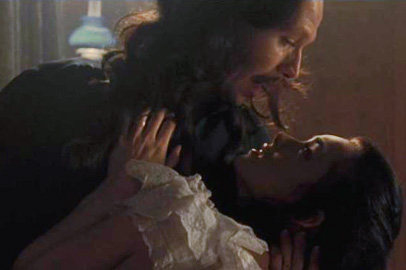
Image is of Gary Oldman as Dracula and Winona Ryder as Mina Harker in the 1992 film, Bram Stoker’s Dracula.
As to why Stoker decided on the gothic genre to convey such blatant sexuality, the gothic genre is arguably one of very few if not the only genre in which it could be socially acceptable to explore the sexual desire of which Victorians disapproved. He mixes it with elements meant to terrify and horrify people, such as vampires, death, and murder. In this way, Victorians had a path to enjoy sexuality while condemning it. This hypocritical way of looking at sexuality might be one way for the opportunity of conversations about acknowledging sexual desire to get a foot in the door. Or perhaps the horror of sexuality was so ingrained into their minds at the time that it was simply natural to include it in a book about vampires? Sexuality is certainly something repressed, which Freud would relate to ‘the uncanny’ – that is frightening and uncomfortable to us. Freud defines the uncanny as something that is familiar, and that familiarity is what is frightening. Something may be familiar to us because (according to Freud) we have pushed it into the subconscious, repressed it to the point that we are not wholly aware of its existence within us. So when it appears before us, forcing us to contend with what we’ve tried to push into the shadows, it provides perfect fuel for gothic fiction. In the lives of every day Victorians, their nature as sexual beings is what they would have repressed, causing the emergence of sexual desire in Dracula to become the uncanny to them.
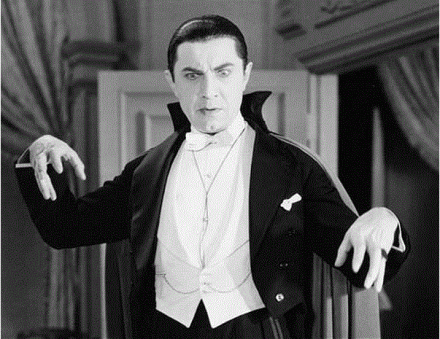
Image is of Bela Lugosi as Dracula.
The first major sexual encounter in Dracula happens when Jonathan Harker falls asleep in the Count’s castle and three women described as voluptuous and beautiful yet animalistic approach him as he wakes, but pretends to sleep. Jonathan describes a “wicked, burning desire that they would kiss me with those red lips.” The girls talk about who should go first in taking ‘kisses’ from him, which unbeknownst to Jonathan actually means biting and taking his blood (potentially killing him). While they follow this encounter by killing a small child, the idea of three beautiful women all wanting a piece of one man is a pervasive male sexual fantasy that has existed for seemingly eons. It’s thrived in many cultures, one of the most famous being the fantasy of a harem originating out of middle eastern cultures and westernized fantasies about India and Muslim culture. Not only does Jonathan get to experience this fantasy, but Dracula himself has also experienced it. An interesting point brought up by R.B. Yeazell in Harems of the Mind: Passages of Western Art and Literature about harems is that westernized fantasies of harems, such as presented in Dracula, exist to “compensate for their [men’s] anticipation of monogamy.” (Yeazell 98) Its notable here that Jonathan gets to experience the harem while he’s engaged, supporting this theory. These fantasies bring a “promise of endless pleasure to the realm of fantasy,” (Yeazell 99) according to the author, and quite literally so in the case of Dracula who offers an eternity of lustful indulgence and the power to take whatever pleasure you desired whether it be gluttony in the form of drinking blood or lust/passion in the form of the ability to seduce nearly whomever you liked. In this way, both good and evil male characters get to partake of the harem fantasy, and so morality does not dictate who is permitted this enjoyment – it belongs to all men.
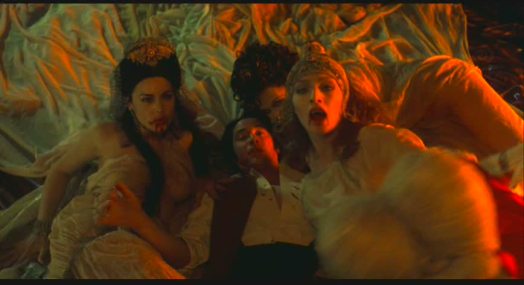
Image is of the three brides of Dracula in bed with Jonathan Harker, from the 1992 film, Bram Stoker’s Dracula. The brides are played by Monica Bellucci, Michaela Bercu, and Florina Kendrick, with Jonathan Harker portrayed by Keanu Reeves.
The women making up Dracula’s vampire harem exist for the sole purpose of being exploited by the men of the novel. They have no backstory and are not fleshed out as characters. Since they are only harem women, their personal tales do not matter to either the male author, who created them only to satisfy sexual desires, or to the male characters – Dracula sees them as underlings, and Jonathan only sees them as objects of sexual desire (blind to the danger at first). While they are suppressed characters in that they are under Dracula’s control, it’s important to note that they are still powerful characters. Their sexuality gives them a sort of control over Jonathan, and their status as inhuman gives them strength and the ability to physically dominate any human male they might choose to. This is the complete reverse of what a proper Victorian male should want. Freud might say that such a desire might be a repressed urge to be controlled by a mother as an adult, but I see it as simply one of sexuality’s many forms. However, at the time, any desire for a dominant woman was seen as perverse because men were almost universally accepted as the dominant half of any relationship. Any man who did desire a woman more powerful than himself would have to repress such desires. Seeing them in print in the form of three beautiful women would probably terrify proper Victorian males because they would see in the women the fantasies they fought to keep out of mind (an emergence of the uncanny, according to Freud) while they most likely had to make do with a ‘proper’ chaste wife.
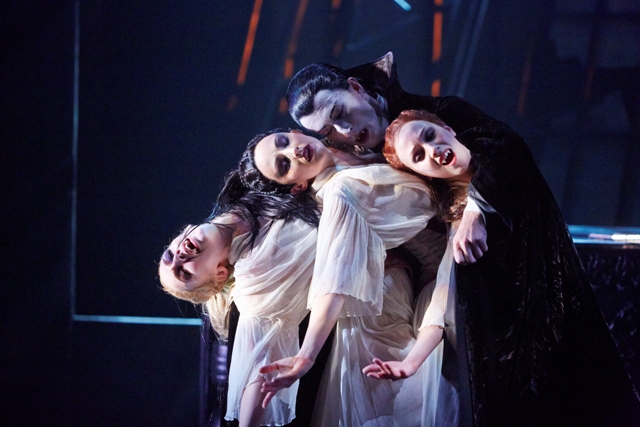
Image is of Dracula with his three brides, as portrayed at West Yorkshire Playhouse by Northern Ballet. Dracula is played by Tobias Batley, and the brides are played by Jessica Morgan, Hannah Bateman, and Antoinette Brooks-Daw.
This brings the topic to Mina Murray/Harker and Lucy Westenra, the two main women of the novel. They embody the proper, virginal, Christian woman waiting dutifully on her husband. They guard their virginity for one man alone (their future husbands), which is highly different from the three vampire women. The vampire women express sexual interest in Jonathan, while also clearly having been involved with Dracula. This can give the vampires the same allure as a prostitute in Victorian society – a being that men were not supposed to associate with, but did so in the dark of night and in secret. Mina and Lucy are a complete contrast and assumedly have no experience sexually. They would have to rely on their husbands to guide/dominate them in bed. In modern day terms, they embody a ‘virginity fetish’ which was mandatory for unmarried women at the time. This was an appropriate avenue of desire for men and women, within the context of a marriage bed and with one, virginal individual. Lucy strays slightly – she has several suitors from which she has difficulty choosing the right one for her. In this way, she’s a little more promiscuous, even going as far as to wonder why it’s not permitted for her to marry three men at once. Her encounters with Dracula and subsequent vampirism can be viewed as punishment for straying from her ‘proper’ path – or possibly making commentary that desire for multiple men can only lead to an evil existence, similar to Dracula’s existence as a man with multiple wives.
In contrast is Mina who states, “I have nothing to give him (Jonathan Harker, her fiancé) except myself, my life, and my trust, and that with these went my love and duty for all the days of my life.” (Stoker 104). While Mina does encounter hardship, she is ultimately granted a happy ending complete with a loving husband and a son. This is perhaps a reward for her dedication and purity. Even though she’s not entirely pure (as evident by the scene where Dracula forces her to drink his blood in almost a rape analogy of a scene), she did not succumb to Dracula and had to be forced, so it is not her fault, and she is not punished with transformation/death.
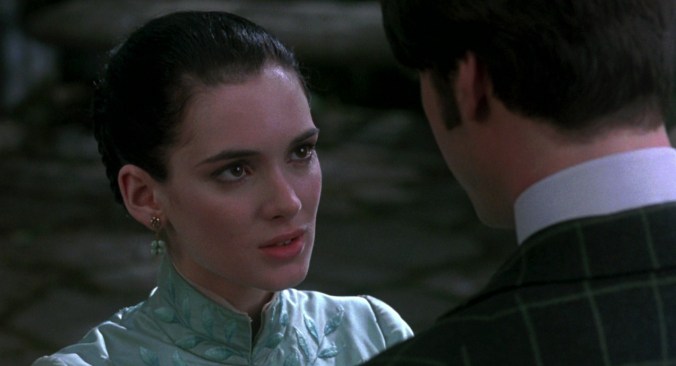
Image is of Winona Ryder in the 1992 film, Bram Stoker’s Dracula, alongside Keanu Reeves as Jonathan Harker.
An interesting comparison that ties together the unholy, sexuality, and purity is bringing religious thought into the mix – a very heavy influence in Victorian society and for Stoker, as evident that crosses and other Christian holy symbols are harmful to the impure vampires. In Judeo-Christian mythology, the creation story for the Abrahamic faiths features a ‘fall’ of human beings when Eve then Adam accept a fruit from a talking snake who convinces them to accept knowledge that god has forbidden them. There are different perspectives on this serpent depending on the group, but the one I would like to focus on is the Christian perspective that this serpent is either a representative or the actual embodiment of the Christian devil. This serpent is a demonic being offering taboo pleasure/knowledge – something humanity is not supposed to reach for but can’t help but yearn for no matter how they try to repress it. A snake also possesses a set of fangs. Arguably, the vampire as portrayed by Bram Stoker plays the same exact role. Dracula offers forbidden fruit to various characters – lust, gluttony, and desire for power. Things humans crave but are taught not to allow to come to the surface. According to the Abrahamic narrative, both men and women did accept the forbidden knowledge/pleasure from the serpent and learned to live with the ensuing results. Therefore, it might be an accurate interpretation to say that we are indeed meant to take at least a small taste of the vampire’s offer. Of course, during Victorian times it would have been beyond scandalous to outright say such a heretical claim. Perhaps it was an unintentional insinuation as in the end the vampire/serpent represented is defeated, but it is still present throughout the rest of the story and offers a unique possible glimpse into the repressed sexual psyche of Victorian men and women who longed for a taste of something more.
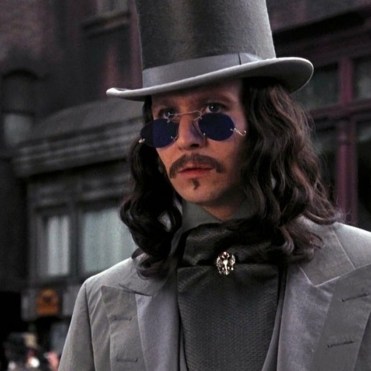
Image is of Gary Oldman as the title character in the 1992 film, Bram Stoker’s Dracula.
To me, the most obvious symbol of repressed sexuality is Dracula himself. He is powerful, he is horrific, he is in control, he has many women, and he takes whatever he wants. The very act of sustaining himself is a penetrative exchange of fluids: biting with his fangs to suck blood. He can break into women’s bedrooms with ease to access whatever soft flesh he desires: first it can be assumed were his three vampire brides (before the novel begins), second is Lucy, and third is Mina. But Dracula doesn’t only embody male sexuality – he’s also slightly feminine. In chapter twenty-one when he sneaks into Mina and Jonathan’s bedroom, he cuts open his chest and feeds her in what reads like a demonic, male version of breastfeeding – a distinctively feminine act. The way I see it, this paints Dracula as both masculine and feminine, and powerful over all genders of all species. He is the ultimate avatar of all sexuality and all desire through which Victorian readers could secretly wish to be or wish to be with while outwardly condemning him for the unholy monster he is. Men could even read the text and secretly desire to have him, or be him, because of that hint of femininity that leaves him straddling different gendered aspects and not completely fitting into one. It’s a perfect cover.
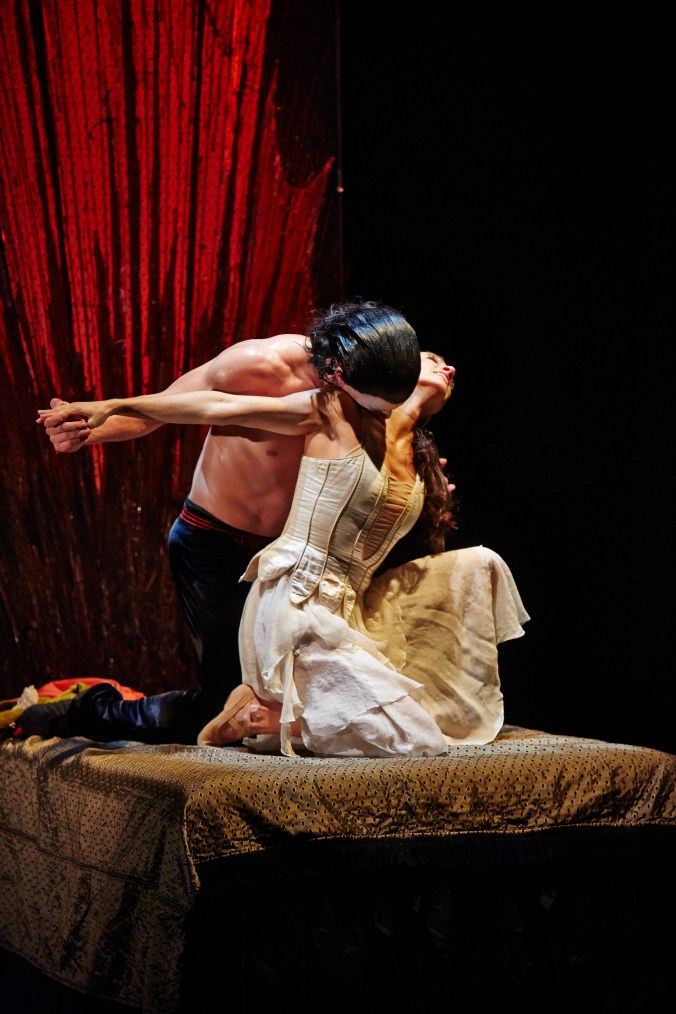
Image is of Tobias Batley as Dracula and Martha Leebolt as Mina Harker in Northern Ballet’s production of Dracula.
Or perhaps Dracula really is just a condemnation of sexuality? I don’t believe so. If it was, it wouldn’t spend so much time describing the details of desire. Dracula is a thriller, meant to get blood and thoughts of repressed sexuality racing in its Victorian readers in a way that would make Freud excited. As society has progressed, sexuality is far less demonized (in most places) than it once was, in part thanks to gothic novels that allowed sexuality its room in the public eye. It made discussion of sexuality less taboo. Even now, vampirism in gothic tales serve as avenues for various forms of repressed sexuality, opening doors for what we try to hide ourselves from. I cannot say if that was Bram Stoker’s true intention for certain, but I would not be surprised at all if he wasn’t at least a little glad for the outcome: vampires as a way to explore what we outwardly deplore but secretly lust after for generations of readers, and many more to come.
Bibliography
Freud, Sigmund. The “Uncanny” Trans. Alix Strachey. 1919.
Stoker, Bram. Dracula. New York, NY: Barnes and Noble, 2003. Print.
Yeazell, Ruth Bernard. Harems of the Mind: Passages of Western Art and Literature. New Haven: Yale UP, 2000. Print.


Pingback: The Popularity of Unhealthy Romances – A Look at Twilight and Fifty Shades of Grey | Evelyn Silver
In your essay you claim that Dracula “forces Mina to drink his blood”. But in Coppolla’s version, he initially refuses to bite her at the Cinematograph, then, when he comes to her in her bedroom, he again refuses to turn her because ‘he loves her too much to condemn her’, he confesses. The choice to suckle him is completely left up to her. The way Gary Oldman played that whole scene was almost orgasmic as it appeared that he had achieved that end as she drank from his breast. When he embraced her afterward, it made me think of perhaps the moment he had first experienced his greatest physical pleasure with the love of his life, Elsibetta his deceased wife, that he just wanted to hold her to him in the afterglow of that final moment as if reliving it again. It was a very tender moment too soon interupted by the men who burst into the room.
The other scene I thought most endearing was when he first spots Wilamina on the crowded street in London. He strikes an impressively handsome image as simply a young man who spots a beautiful young woman across a crowded street, fixates on her while calculating how he will encounter her and get her into his orbit. He begins by saying, ” See me. See me now” which causes her to glance in his direction briefly not realizing why she looked at him. He basically was speaking into her mind. By the end of the introduction, he had already claimed her by guiding her down the crowded sidewalk with his hand at the small of her back which is a public posturing of possession or ownership if you will. It suggests to anyone who notices that ‘she is with me and only me’. Very sexy.
Lastly, the Absinthe scene. He is projecting into her mind that which he wants to hear from her lips, but in her words to strike familiarity as if speaking with the reincarnation of his long dead princess. ”You speak of my home as if you have seen it first hand.” (paraphrased) But it was just enough to draw him deeper into her and he leans his face slightly closer to hers as he studies her features, wanting to kiss her. But she stands up before that happens. This to me was a love story between the damned and the virtuous, each wanting to embrace the other. Even after he presses her hand to his chest and informs her that “There is no life in this body”, she is horrified, she is angry, she is fearful, but she still wants him after all is said and done.
LikeLike
Thanks for your comments! Those are very noteworthy moments.
Just to clarify though, this essay isn’t about the Coppolla version, or any other cinematic version, just the original novel, and no other versions. In the original novel, Mina is very much being attacked by a monster and is only horrified by it. Dracula isn’t wanting to spare her from anything, and I don’t think he in any way loves her as much as lusts for her, if even that. Honestly, the way he uses and discards women throughout the novel indicates to me that Mina isn’t really anything that special to him as much as another victim he’s currently cultivating for the thrill of the hunt, who would ultimately have been discarded from his attentions the way his other brides have little care or attention from him and the way Lucy was abandoned to her fate at the hands of the vampire hunters. There’s sexual overtones to his behavior, obviously, but I think love and lust in any human way are meant to be pleasures this version of a vampire can’t experience.
In the original novel, Dracula is abusive and completely disregards Mina’s consent in every way. In fact, the scene where he forces her to drink his blood in the bedroom he threatens her that if she doesn’t do as he says, he’ll kill her sleeping husband right there in front of her (if I remember correctly, the threat is he’ll bash out Jonathan’s brains?). That doesn’t convince her completely as she’s still strongly repulsed by him on a visceral level despite wanting to save her husband’s life, so he basically pushes her in a way so that she has to either suffocate against his chest or drink his blood. “…he cut himself across his breast and pressed Mina’s mouth to the wound, so that she either had to suffocate or drink the blood.”
Her response when recounting this is only horror, and I don’t believe there’s any point in which she wants him when all is said and done. I think writing this scene this way is meant to show the audience that she’s truly a good person, to reassure the audience that she had absolutely no choice but to partake in this unholy, erotic experience, so we can write and read about it and enjoy it while pretending we’re only rooting for the good Mina to escape his clutches rather than basking in the erotic thrill. Its non-con “romance”, but for Victorians.
I love the movie versions, and the sexy reimagining of Dracula! They’re worthy of their own essays! But this essay isn’t about that, it’s strictly analyzing the original novel’s text and its context in Victorian society.
LikeLike
Pingback: Vampires, Queers, and Jews: Why I Love the Horror of Power | Evelyn Silver